Vacuum system simulation: pumping speed, conductance and pumpdown curves
Assemble a vacuum system from real ConFlat parts, seal every port, and simulate it. Vacuum Assembler calculates the effective pumping speed at your chamber, the conductance of each part in the line, and the full pumpdown curve with outgassing, then saves a report you can share.
Effective pumping speed
Pumps are rated at their inlet flange, but every tee, elbow, reducer and nipple between the pump and your chamber costs speed. The simulator combines the parts' molecular conductances, including side ports and the chamber itself, into the speed you actually get at the chamber.
Results: effective speed and percent of rated speed, per-part conductance, line conductance, and a 3D map colored from red (little pumping) to green (full speed).
Pumpdown curve
From atmosphere to base pressure: roughing with a scroll, rotary vane or diaphragm backing pump, turbo pump run-up, and the long outgassing-limited tail. Choose unbaked or baked surfaces, add a leak rate, and set a target pressure.
Results: pressure versus time (log or linear), time to 1, 10⁻³, 10⁻⁶ Torr and your target, and a breakdown of which parts set the final pressure.
How it works
How is effective pumping speed calculated?
The assembly is solved as a network of parts. Each part's port-to-port transmission probabilities come from a Monte Carlo (test-particle) calculation on its CAD geometry, joints are matched by flange, and the pump is a partially absorbing surface set by its rated speed. Solving the network gives the effective speed at the part you measure at, the conductance of each part along the line, and the local pumping speed in every part.
What does the pumpdown simulation include?
Pressure versus time from atmosphere: the backing pump in the viscous regime, conductance that changes from viscous to molecular flow (Knudsen transition), the turbo pump's speed curve and run-up, a leak rate, and outgassing from every wetted surface by material, unbaked (water, falling off about 1/t) or baked.
Which gases are supported?
Nitrogen, hydrogen, helium, argon, water vapor and air, using each gas's mean molecular speed and viscosity and the pump's datasheet speed for that gas where available.
What do I get out of it?
Effective pumping speed, a colored map of local pumping speed, conductance along the pumping line, time to reach each pressure, the pressure after 1, 8 and 24 hours, which parts' outgassing sets the base pressure, and a full HTML report with the bill of materials and flange hardware.
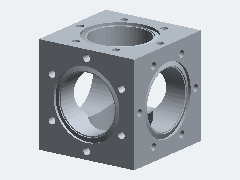 CF 2.75″ 6-port chamber
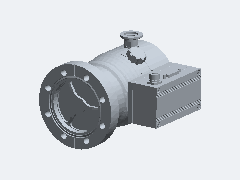 Pfeiffer HiPace 80 turbomolecular pump (CF 4.5″)